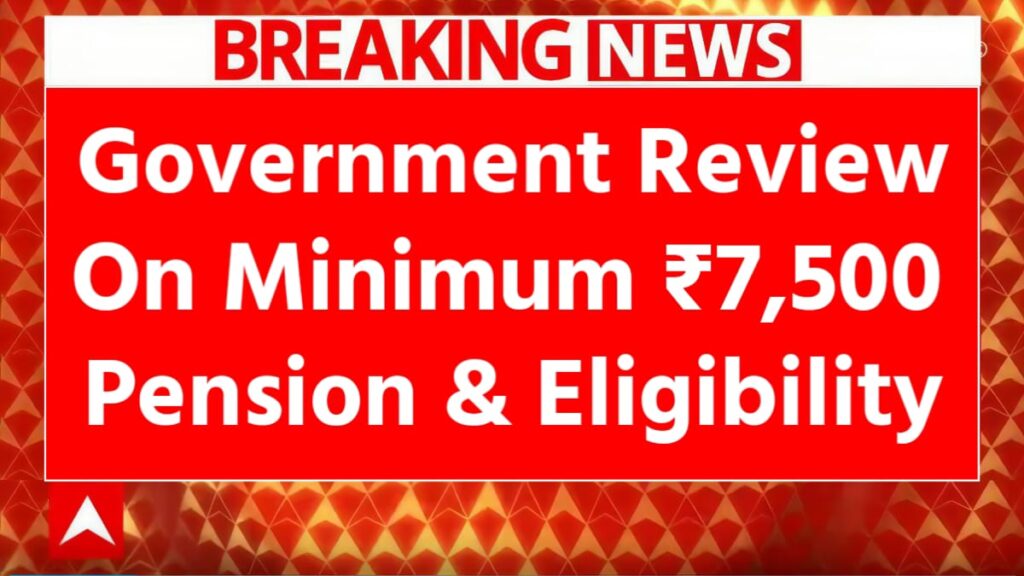
2026 EPS 95 Pension Update: A renewed debate around retirement security has brought the Employees’ Pension Scheme (EPS-95) back into focus. According to reports and discussions within policy circles, the government is examining a proposal to raise the minimum monthly EPS pension to ₹7,500. While no official notification has been issued so far, the issue has gained traction amid rising concerns over the adequacy of private-sector pensions.
The EPS-95 scheme, introduced in 1995, was intended to provide a steady post-retirement income to organised-sector employees covered under the provident fund framework. However, inflation over the past two decades has reduced the real value of pensions. Many retirees today receive between ₹3,000 and ₹5,000 per month an amount widely seen as insufficient for healthcare, housing, and daily expenses. The proposed revision is therefore being discussed not just as a financial change, but as a structural response to ageing demographics.
Why the Minimum Pension Debate Has Intensified in 2026
The demand to raise the minimum pension is not new. Pensioners’ associations have for years argued that EPS payouts have not kept pace with inflation or rising medical costs. What has changed in 2026 is the broader national conversation around social security reform and financial protection for senior citizens.
यह भी पढ़े:
 Bank Holiday Schedule: All Banks to Be Closed 18–22 February 2026 and What Customers Should Know
India’s ageing population is expanding, and a large portion of private-sector retirees depend solely on EPS income after retirement. Unlike government pensioners who receive dearness allowance adjustments, EPS beneficiaries do not have an automatic cost-of-living revision mechanism. According to policy observers, this structural gap has amplified calls for a fixed minimum threshold such as ₹7,500, which may serve as a baseline rather than a complete solution.
Understanding How EPS-95 Pension Is Calculated
The Employees’ Pension Scheme functions under the supervision of the Employees’ Provident Fund Organisation (EPFO). Members who complete at least 10 years of contributory service become eligible for a monthly pension upon reaching retirement age. The pension amount is calculated based on pensionable salary and years of service.
In practical terms, employer contributions fund the pension component, while employees contribute to the provident fund corpus. Over time, wage ceilings and formula structures have influenced final pension outcomes. For many workers who retired years ago, lower wage caps have resulted in modest monthly payouts. This is one reason why pension adequacy remains a persistent issue among earlier retirees.

What a ₹7,500 Floor Could Mean for Retirees
An increase from current minimum levels to ₹7,500 may appear moderate on paper, but for pensioners managing fixed incomes, even a ₹500–₹1,000 rise can influence monthly budgeting decisions. In smaller cities, that additional amount may help cover cooking gas, electricity bills, or recurring medicines for chronic conditions such as diabetes or hypertension.
Consider the example of a retired factory supervisor receiving ₹4,200 per month. After paying rent and basic groceries, little remains for medical consultations. If the minimum pension is raised, it may reduce dependence on family members. Economists point out that pension income typically circulates within local economies, benefiting neighbourhood pharmacies and small retailers.
Fiscal Considerations and Administrative Challenges
While the humanitarian case for revision is strong, fiscal implications cannot be ignored. Raising the minimum pension for millions of beneficiaries would require substantial financial allocation. Budgetary support from the central government may be necessary, particularly if contribution levels do not fully support higher payouts.

An economist familiar with pension policy explains, “Any upward revision must balance immediate relief with long-term sustainability. Without structural funding adjustments, periodic revisions may become fiscally difficult.” Some experts suggest phased implementation or prioritising the oldest pensioners as an interim measure. Others recommend linking pensions to an inflation index to avoid recurring political negotiations.
Implementation Process and Eligibility Clarification
If approved, existing pensioners may receive revised amounts automatically through the current digital disbursement system. As per guidelines, payments are credited directly into linked bank accounts. There is generally no need for reapplication unless specific documentation updates are required.
However, pensioners are advised to ensure Aadhaar linkage, KYC compliance, and updated bank details to avoid transaction delays. Verification is recommended through official EPFO portals and bank communications rather than relying on social media forwards. This may vary by case depending on service history and pension category, including family pension or widow pension arrangements.
Comparison With Past Revisions and Structural Gaps
Historically, EPS pension revisions have been incremental rather than transformative. Earlier increases raised the minimum pension to ₹1,000, which at the time provided limited relief. Compared to that baseline, a ₹7,500 threshold would represent a significant policy shift, though still modest relative to urban living costs.
The broader issue remains the absence of automatic inflation adjustments. Government retirees receive dearness relief based on price indices, whereas EPS pensioners depend on periodic policy decisions. Without structural reform, future erosion of value may continue, even if the minimum amount is enhanced now.
What Pensioners Should Monitor Going Forward
As of now, the ₹7,500 proposal remains under examination. No formal circular or gazette notification has confirmed implementation dates. Pensioners should track updates through official EPFO announcements, Union Budget documents, and verified press releases.
In practical terms, beneficiaries should review service records and maintain updated documentation. According to reports, if the proposal is cleared, it may come into effect during the 2026–27 financial year, subject to administrative readiness and budget approvals. Until then, any figures circulating online should be treated cautiously.
Disclaimer: This article is based on publicly discussed proposals and available policy discussions regarding a possible revision of the EPS-95 minimum pension. No official approval or implementation timeline has been confirmed at the time of writing. Pension amounts, eligibility conditions, and effective dates may change following formal government notification. Readers are advised to verify details through official EPFO communications and authorised government sources before making financial decisions.