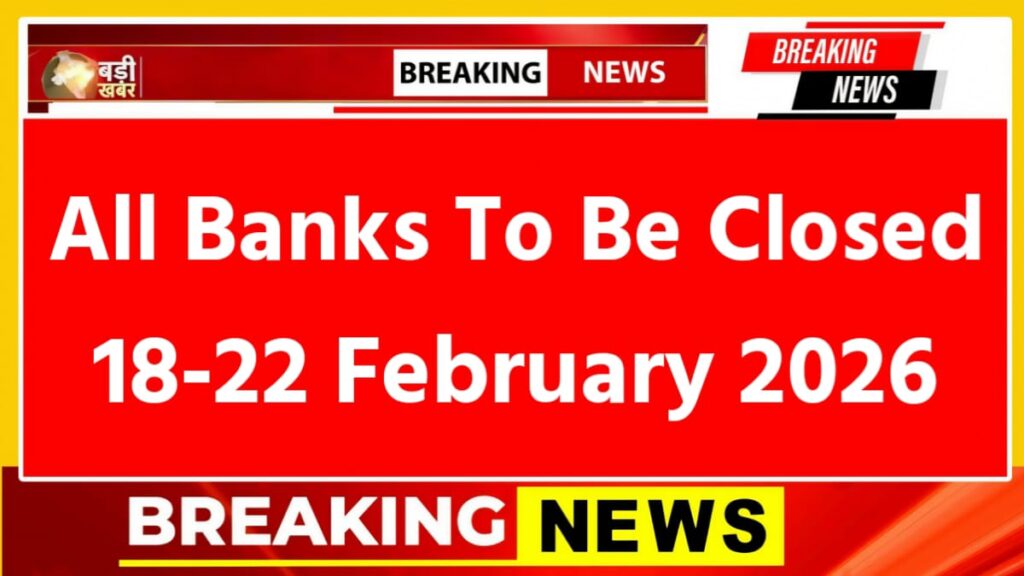
Bank Holiday Schedule: Bank customers in several parts of India may experience limited branch access between 18 and 22 February, as per the annual holiday calendar issued by the Reserve Bank of India (RBI). While bank holidays are routine and largely state-specific, the clustering of observances this week has drawn attention because multiple closures fall within a short span. For individuals and businesses that depend on in-person banking such as cheque deposits, demand drafts, or document verification planning ahead could help avoid delays.
According to reports and official holiday listings, these closures are linked to regional festivals, commemorative days, and the regular weekend schedule. Importantly, this is not a nationwide shutdown. The impact varies by state and by the category of holiday under RBI guidelines. Digital services are expected to function normally, though certain branch-linked processes may take longer than usual.
Regional Observances Behind the February Closures
The sequence begins with Losar celebrations in select Himalayan regions on 18 February. Losar marks the Tibetan New Year and is observed widely in parts of northern and northeastern India. Banks in affected areas remain closed to enable participation in local festivities. The following day, 19 February, certain states observe birth anniversaries of prominent regional leaders, leading to additional branch closures.

On 20 February, some northeastern states commemorate their Statehood Day, marking their formation within the Indian Union. These holidays are not uniform across the country. In practical terms, a customer in Delhi may see regular banking operations, while a customer in Sikkim or parts of the Northeast could face branch closures on the same date. This variation highlights the federal structure of India’s banking holiday framework.
Weekend Alignment Adds to the Perception of Extended Shutdown
The perception of a longer break is amplified by the regular Sunday closure on 22 February. When state-specific holidays fall close to weekends, customers often interpret it as a continuous five-day shutdown. However, the actual closure period differs by location and bank branch.
This pattern is not new. Similar clustering has been observed during Diwali, regional New Year celebrations, and other cultural observances in previous years. According to banking analysts, “Holiday clustering tends to create operational bottlenecks mainly in cheque clearing and inter-branch documentation processes, rather than digital transactions.” The statement reflects how modern banking systems continue functioning even when physical counters are closed.

Which Banking Services May Be Affected
Even during branch holidays, customers can continue using digital platforms such as UPI, IMPS, internet banking, and ATMs. Fund transfers, bill payments, standing instructions, and most online transactions remain operational 24/7. In many cases, the increasing reliance on digital payments has reduced dependence on branch visits.
However, services tied directly to branch operations may face delays. Cheque clearing under the Negotiable Instruments Act category could be postponed if clearing cycles overlap with holidays. Similarly, branch-initiated RTGS transactions might not be processed on certain holiday classifications. Businesses relying on physical instruments for supplier payments should factor in possible time lags.
Implications for Households and Small Businesses
For individual customers, the most noticeable inconvenience may involve tasks that require physical presence. Opening new accounts, updating KYC records, submitting loan documentation, or obtaining demand drafts generally require branch interaction. If such tasks are scheduled during holiday periods, processing may be deferred to the next working day.
यह भी पढ़े:
 2026 EPS 95 Pension Update: Government Review on Minimum ₹7,500 Pension and Eligibility Details
Consider a small trader in Mumbai who deposits a cheque on 17 February drawn on a bank branch located in a northeastern state observing a holiday on 18 February. In such a case, fund realisation could take longer than usual. While the system continues operating nationally, local observances may influence clearing timelines. Planning deposits a few days earlier may help mitigate uncertainty.
Understanding RBI Holiday Categories
The RBI classifies bank holidays into three broad categories: holidays under the Negotiable Instruments Act, RTGS holidays, and “Closing of Accounts” days. Each category affects different services. Negotiable Instruments Act holidays typically impact cheque clearing and branch counters. RTGS holidays relate to high-value real-time settlements processed through bank branches.
“Closing of Accounts” holidays generally occur at the end of the financial year and involve internal bookkeeping adjustments. This structured classification helps banks communicate service availability clearly. Based on available documents, customers should note that digital platforms often operate independently of these classifications, although settlement timelines may vary depending on transaction type.
How to Verify Local Branch Working Days
Because bank holidays differ by state, relying solely on national news reports may not provide complete clarity. Customers are advised to check official bank websites, mobile applications, or notices displayed at local branches. Most banks publish a state-wise holiday list at the beginning of each year, which remains accessible throughout.
Customer care helplines and SMS alerts can also provide updated information for urgent transactions. Verification is recommended, especially when scheduling high-value transfers, cheque deposits, or documentation deadlines. This simple step can prevent last-minute disruptions and ensure smoother financial planning.
Why Digital Infrastructure Softens the Impact
India’s expanding digital payment ecosystem has significantly reduced the operational impact of branch holidays. UPI transactions continue round-the-clock, and ATM networks function independently of branch status. In practical terms, most day-to-day payments, including utility bills and retail purchases, remain unaffected.
However, complete independence from branch services is not yet universal. Regulatory processes, paper-based instruments, and certain loan procedures still require physical verification. While digital adoption is increasing each year, a hybrid system continues to operate. Customers who anticipate such requirements may consider completing them before extended holiday periods.
Disclaimer: This article is based on publicly available banking holiday schedules and general RBI guidelines. Actual branch operations may vary by state, bank, and local administrative decisions. Customers are advised to verify exact closure dates and service availability with their respective banks before scheduling important financial transactions. Digital services usually remain operational, but processing timelines for certain instruments may differ depending on regulatory and operational conditions.